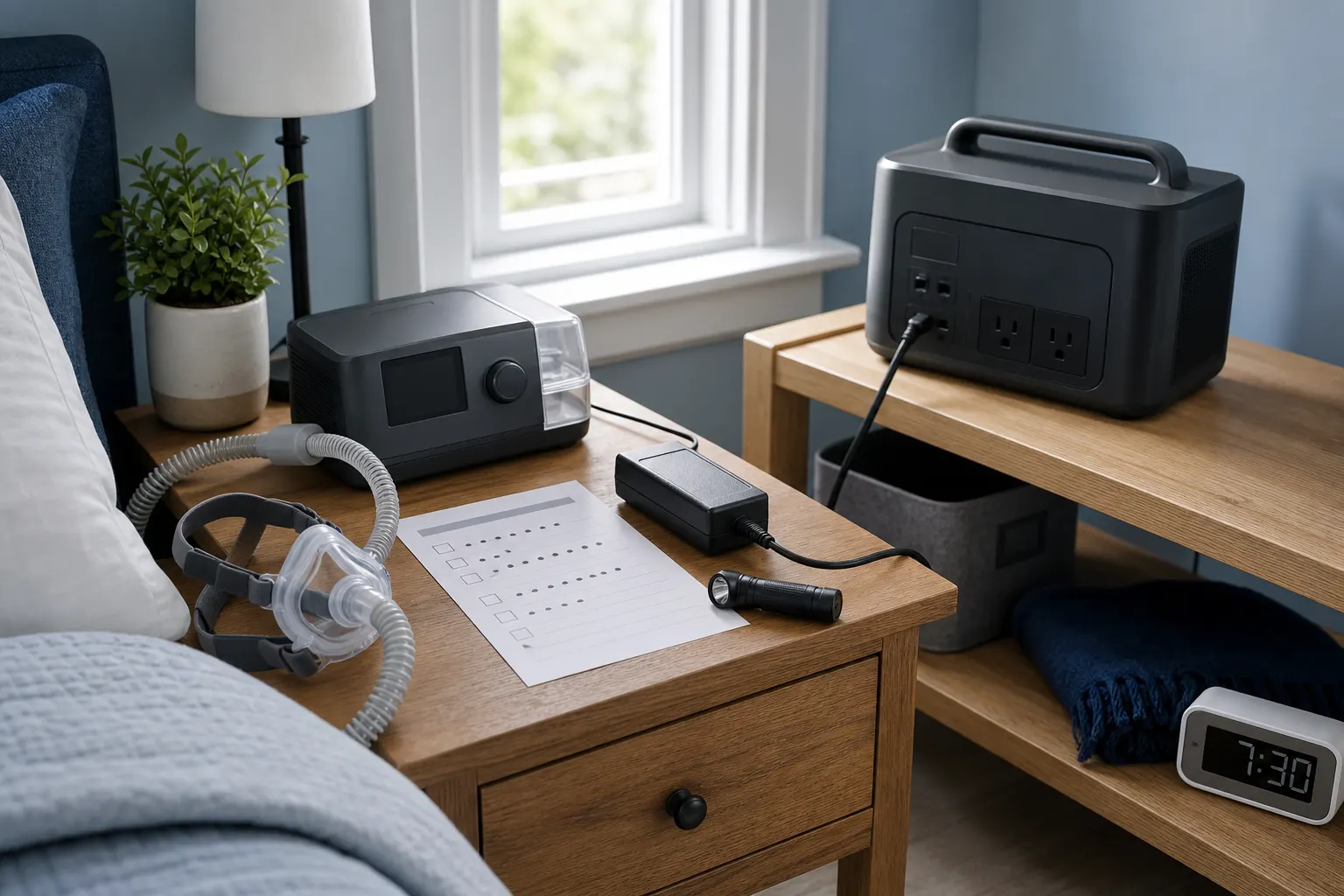
Safety-First Short Answer
The best portable power station for CPAP backup is not a single universal product. It is the setup your CPAP manufacturer, medical supplier, and clinician/provider say matches your exact machine, pressure settings, humidifier or heated tubing use, power accessory, and required runtime.
Use these product classes only as planning references:
- Small-load reference after device-specific checks: EcoFlow RIVER 2 class
- Larger-capacity reference after device-specific checks: Anker SOLIX C1000 class
This guide does not say either station is medically suitable for your CPAP. It compares manufacturer specifications, Canadian Lung Association CPAP guidance, ResMed power-accessory guidance, Government of Canada power-outage guidance, and Canada Ready Home product notes.
Before relying on any backup-power setup, check your CPAP manual, power supply label, manufacturer guidance, medical supplier, and clinician/provider.
Start With Your CPAP Device, Not The Battery
CPAP backup is different from phone or router backup because the device is part of prescribed therapy.
The Canadian Lung Association says CPAP machine pressure is prescribed, and that doctors, sleep specialists, and medical suppliers help people choose CPAP equipment. That means the battery question should start with the exact prescribed setup, not with an Amazon.ca product listing.
Write down:
- CPAP brand and model
- pressure setting or pressure range
- whether you use a humidifier
- whether you use heated tubing
- whether oxygen or another device is involved
- the AC power supply rating
- whether the manufacturer offers a DC cable, converter, or battery guide
- how many hours of backup you need
- what you will do if backup power is not enough
Then ask your provider, supplier, or manufacturer what backup-power setup is acceptable for that exact equipment.
Canada-First Buying Context
Power outages in Canada can be brief, but storms, wildfire evacuations, ice events, and winter weather can make backup planning more serious.
The Government of Canada recommends emergency planning and lists backup power options such as batteries or power banks. For CPAP users, that general advice is only a starting point. CPAP backup planning may also involve:
- your device manual
- your medical supplier
- manufacturer battery and accessory guidance
- a plan for longer outages
- a plan for travel or evacuation
- your local utility or emergency contacts if electricity is medically important
Do not wait for a storm warning to find out which cable, inverter, or battery your CPAP requires.
Reference Comparison
| Reference class | Planning role | Capacity / output notes | CPAP check |
|---|---|---|---|
| EcoFlow RIVER 2 | Small-load reference after device-specific checks | 256 Wh, 300 W AC output class | Only consider after confirming your CPAP setup, accessory, and runtime need; do not assume overnight therapy support |
| Anker SOLIX C1000 | Larger-capacity reference after device-specific checks | 1,056 Wh, 1,800 W AC output class | More capacity does not prove medical suitability; exact CPAP model, accessory, settings, and safety plan still control the decision |
This page uses reference classes only. CPAP backup is safety-sensitive, so do not choose a product until your exact machine, accessory, settings, and backup plan have been checked with qualified guidance.
Product Reference Notes
Small-Load Reference After Device-Specific Checks: EcoFlow RIVER 2
The EcoFlow RIVER 2 is a compact portable power station class. EcoFlow Canada lists the RIVER 2 as a 256 Wh station with a 300 W AC output class.
That can be useful as a planning reference for small electronics, but CPAP use should not be assumed from the product size alone. A CPAP setup may draw differently depending on device model, pressure, humidifier, heated tubing, DC accessory, AC inverter use, and runtime target.
Do not treat this class as a CPAP recommendation unless:
- your CPAP manufacturer or supplier confirms the power setup is appropriate
- you know whether you are using AC or a manufacturer-supported DC accessory
- your runtime need leaves a margin
- you have a plan if the battery is not enough
Larger-Capacity Reference After Device-Specific Checks: Anker SOLIX C1000
The Anker SOLIX C1000 is a larger portable power station class. Anker Canada lists the C1000 as a 1,056 Wh class unit with 1,800 W AC output.
More capacity can give more planning headroom, but it still does not prove CPAP suitability. The deciding factors remain the exact CPAP setup, supported accessories, output type, runtime need, and qualified guidance.
Do not treat this class as a CPAP recommendation unless:
- the CPAP manufacturer, supplier, or provider confirms the setup
- the output type and accessory match the device
- you understand how humidifier and heated tubing use affects planning
- you have a longer-outage backup plan
AC vs DC Power: Ask Before You Buy
Some CPAP manufacturers publish battery or DC-converter guidance for specific machines. ResMed, for example, publishes a battery guide and device/accessory documentation. Those documents show why the exact machine and accessory matter.
Do not assume a generic cable, third-party adapter, or power station outlet is suitable. Check the CPAP manual and manufacturer guidance before using a battery, inverter, DC converter, or adapter.
Humidifier And Heated Tubing Checks
Humidifiers and heated tubing can change power planning. They may also be part of comfort and therapy adherence for some users.
Canada Ready Home is not recommending that readers turn off prescribed or advised CPAP features to extend battery life. Ask your clinician/provider, manufacturer, or supplier before changing how you use your device.
How To Plan The Capacity Question
Use the watt-hour calculator only as a rough planning aid after you know your CPAP's power requirements. The calculator is not a medical-device sizing tool.
For a cautious planning workflow:
- Confirm your CPAP model and power accessory.
- Confirm whether the load should be AC or DC.
- Confirm expected power draw from the manual, manufacturer, or supplier.
- Decide the required runtime.
- Add margin for conversion losses, settings, cold storage, and battery aging.
- Make a plan for longer outages.
For general outage math, read the watt-hour outage guide.
Who Should Not Rely On This Article Alone
Do not rely on this article alone if:
- you use oxygen with CPAP
- you use BiPAP, ventilator support, or other respiratory equipment
- missing therapy could create a serious health risk
- you do not know your exact CPAP model or power requirements
- you need to change pressure, humidity, tubing, oxygen, or therapy settings to make a battery last
- you need refrigerated medicine or other medical backup planning
- you need a backup plan for multi-day outages
Use your clinician/provider, medical supplier, manufacturer, and emergency planning resources for those cases.
Where This Fits With Other Power Station Guides
If your CPAP supplier confirms you can use a portable power station and you are choosing a size class, compare:
- Best portable power stations in Canada
- Best portable power stations under 500 CAD
- Best portable power stations under 1,000 CAD
- Portable power hub
Keep CPAP backup separate from ordinary small-load backup. A router going offline is inconvenient. A medical-device backup plan needs qualified guidance.
FAQs
Can a portable power station run a CPAP?
Sometimes, but it depends on the exact CPAP model, settings, humidifier, heated tubing, power accessory, output type, and runtime target. Check your manual, manufacturer, medical supplier, and clinician/provider before relying on a setup.
Is a larger power station automatically better for CPAP?
No. More capacity can help with runtime planning, but the device must still be compatible with the power source and accessory. Bigger is not the same as medically appropriate.
Can I turn off my humidifier to save power?
Do not change prescribed or advised therapy use solely because a battery lasts longer that way. Ask your clinician/provider, manufacturer, or supplier.
Should I use AC or DC output for CPAP backup?
Ask your CPAP manufacturer or supplier. Some manufacturers publish device-specific battery or DC-converter guidance. Do not assume generic adapters are acceptable.
Are there product recommendations on this page?
No. This page includes reference classes only. Do not treat either product class as suitable for your CPAP unless your exact device, accessory, settings, and runtime need have been checked with your manufacturer, medical supplier, and clinician/provider.
Sources
- Canadian Lung Association: CPAP
- Canadian Lung Association: Using a CPAP machine for sleep apnea
- Government of Canada: Power outages - Get prepared
- ResMed: Battery guide
- ResMed: Air11 DC/DC converter user guide
- EcoFlow Canada: RIVER 2 portable power station
- Anker SOLIX Canada: Anker SOLIX C1000