Short Answer
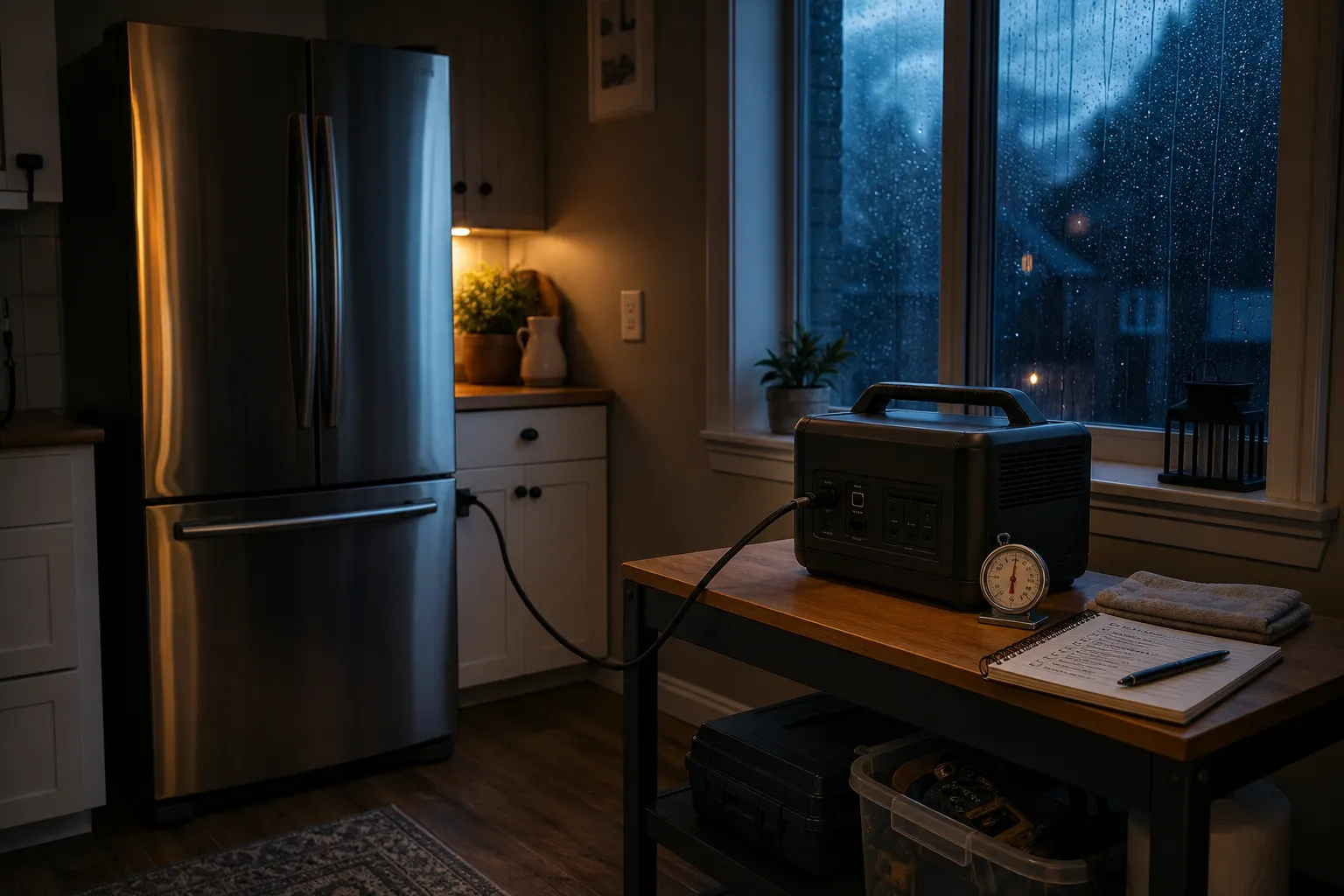
A portable power station can help a fridge or freezer spend less time without power during a storm outage, but it is not a food-safety decision-maker. The useful size depends on the exact appliance, compressor surge, average cycling, room temperature, door openings, starting battery charge, and whether you also plug in other loads.
The current Canada Ready Home comparison order for fridge-backup shoppers is:
- Best balanced fridge-backup comparison: Anker SOLIX C1000 class
- Best higher-output BLUETTI comparison: BLUETTI AC180 class
- Best familiar 1 kWh comparison: Jackery Explorer 1000 v2 class
- Best small-load fallback: EcoFlow RIVER 2 class
This guide compares manufacturer specifications, official Canadian power-outage and food-safety guidance, an Amazon.ca listing check completed on 2026-08-21, and Canada Ready Home product notes. Before buying, check the current Amazon.ca seller, shipper, price, availability, exact model, bundle contents, return policy, and warranty details.
For broader product criteria, start with the best portable power stations in Canada. To estimate loads, use the watt-hour calculator and the watt-hour outage guide.
Canada-First Buying Context
Storm outages in Canada can be short and annoying, or long enough that food, heat, water, internet, and phone charging all compete for attention.
For fridge backup, the mistake is treating the fridge like a steady light bulb. Refrigerators and freezers cycle on and off. The compressor can draw more power when starting than it draws while running. Runtime also changes with:
- fridge or freezer age and efficiency
- how full the appliance is
- indoor temperature
- whether the door stays closed
- starting temperature before the outage
- how often the compressor cycles
- whether the power station is also running a router, lights, phone chargers, or other loads
The Government of Canada says not to open a fridge or freezer unless necessary during an outage, and notes that a full freezer can keep food frozen for 24 to 48 hours if the door remains closed. Health Canada says food that still contains ice crystals or feels refrigerator-cold can be re-frozen if it is cooked to safe internal temperatures, and reminds readers not to eat food they think may be unsafe.
Use a thermometer and official food-safety guidance for food decisions. Use this guide for shopping context.
Quick Comparison
| Product class | Best fridge-backup fit | Capacity / output notes | Main fridge check |
|---|---|---|---|
| Anker SOLIX C1000 | Balanced 1 kWh class for fridge/freezer support plus small essentials | 1,056 Wh, 1,800 W AC output class | Check exact Amazon.ca seller, bundle, current offer, and appliance surge fit |
| BLUETTI AC180 | Higher-output mid-size comparison for shoppers cross-shopping BLUETTI | 1,152 Wh, 1,800 W AC output class | Watch for AC180, AC180P, solar, and charger bundle variations |
| Jackery Explorer 1000 v2 | Familiar 1 kWh comparison with fridge-use claims to verify against your appliance | 1,070 Wh, 1,500 W AC output class | Check current seller, availability, and exact listing details |
| EcoFlow RIVER 2 | Small-device fallback for phones, lights, and router support | 256 Wh, 300 W AC output class | Usually too small for main fridge-backup expectations |
Use the product comparison section below as a starting point, then check the current listing details and your appliance requirements before buying.
Product Notes
Best Balanced Fridge-Backup Comparison: Anker SOLIX C1000
The Anker SOLIX C1000 is the strongest comparison for a Canadian household that wants a portable battery for a fridge or freezer plus a short list of small essentials.
Anker Canada lists the C1000 as a 1,056 Wh class station with 1,800 W AC output. That puts it in a useful middle range: much more headroom than compact stations, without turning the purchase into a hardwired home-backup project.
Choose this class if:
- you want around 1 kWh of battery capacity
- your fridge or freezer specs fit the station's continuous and surge output
- you can charge it fully before a storm
- you will keep the connected loads narrow
- you will check current Amazon.ca seller, warranty, and bundle details
Skip it if:
- you need whole-home backup
- your appliance manual lists requirements beyond the station's output
- you need sump pump, well pump, furnace, stove, or hardwired backup
- you want to avoid all manual model and seller checking
Best Higher-Output BLUETTI Comparison: BLUETTI AC180
The BLUETTI AC180 is the main BLUETTI comparison here. It is a cleaner mid-size option than larger bundle-style alternatives when the goal is fridge support from a portable 1 kWh class station.
BLUETTI Canada lists the AC180 as a 1,152 Wh class unit with 1,800 W AC output. For fridge-support shopping, that makes it a serious cross-shop against the Anker C1000 class.
Choose this class if:
- you want a BLUETTI option around the 1 kWh range
- you value higher AC output in a mid-size station
- you can verify the exact model and seller before buying
Skip it if:
- the listing mixes AC180, AC180P, solar, or charger bundles
- weight and storage are bigger concerns than output
- you cannot confirm the appliance startup requirement
Best Familiar 1 kWh Comparison: Jackery Explorer 1000 v2
The Jackery Explorer 1000 v2 is included because many Canadian shoppers compare Jackery against Anker, EcoFlow, and BLUETTI when looking for emergency or camping power.
Jackery Canada lists the Explorer 1000 v2 as a 1,070 Wh class station with 1,500 W output. Jackery also presents fridge and portable-refrigerator use cases on its Canadian product page, but your own fridge can behave differently. Check the appliance label and manual before relying on any example runtime.
Choose this class if:
- you want a familiar portable-power brand around 1 kWh
- the current Canadian seller, warranty, and return policy check out
- your fridge's running and starting load fit the station
Skip it if:
- the Amazon.ca seller or listing details are unclear
- you want the highest AC output in this comparison
- you cannot verify the current seller, shipper, price, and availability
Best Small-Load Fallback: EcoFlow RIVER 2
The EcoFlow RIVER 2 is not the main fridge-backup recommendation. EcoFlow Canada lists it as a compact 256 Wh, 300 W AC output class unit.
That can be useful during a storm for phones, LED lights, laptop top-ups, a small router, or other communications loads. It is not the right starting point if the primary job is keeping a full-size fridge or freezer powered.
Choose this class if:
- you mainly need a communications and light kit
- portability matters more than fridge runtime
- you already have another plan for refrigerated food
Skip it if:
- the fridge or freezer is the main load
- you expect to power multiple AC devices at once
- you want room for compressor surge and longer runtime
How To Size A Power Station For A Fridge
Start with the appliance, not the product listing.
- Find the fridge or freezer label and manual.
- Note running watts or amps, voltage, and any startup or compressor-surge information.
- Estimate the other loads you might plug in at the same time.
- Use the watt-hour calculator for a rough planning estimate.
- Leave headroom because power stations lose some energy through inverter conversion and appliance cycling is variable.
If your appliance has no clear startup information, contact the manufacturer or use qualified electrical help. Do not assume a fridge that averages a modest number of watts will start cleanly on every battery inverter.
Fridge And Freezer Use Guidance
Keep The Load Narrow
During an outage, a fridge-support battery should not become the household power bar. Every phone, lamp, laptop, modem, fan, or small appliance reduces the battery left for cooling.
If fridge or freezer support matters, decide in advance what else is allowed on the station.
Keep Doors Closed
Government of Canada guidance says not to open the fridge or freezer unless necessary during an outage. This matters whether or not you have a battery.
A power station can reduce the appliance's unpowered time, but it does not undo frequent door openings, warm indoor conditions, or food that was already marginal before the outage.
Do Not Treat Runtime As Food-Safety Advice
Food-safety decisions depend on actual temperature and condition. Health Canada says food that still contains ice crystals or feels refrigerator-cold can be re-frozen if it is cooked to safe internal temperatures, and also says food contaminated with bacteria may not smell bad or look spoiled.
When in doubt, follow official food-safety guidance rather than a product runtime estimate.
Plan Charging Before The Storm
The best fridge-backup station is the one that is charged before the outage.
Keep a routine for:
- checking battery charge before forecast storms
- storing the station within manufacturer temperature guidance
- knowing where the AC cable and extension cord are
- keeping the station off wet floors
- deciding which loads get priority
For winter storage and charging checks, read the cold-weather portable power guide.
When A Fuel Generator Is A Better Fit
A portable battery is quiet, indoor-usable within its manual, and helpful for small emergency loads. It is not a replacement for every backup-power job.
Consider the portable power station vs generator guide if you need:
- long multi-day runtime
- multiple large appliances
- sump pump or well pump backup
- furnace or hardwired system support
- repeated recharging without grid power
Fuel generators have carbon monoxide and placement risks. Follow official safety guidance and manufacturer instructions if you use one.
Who Should Skip This List
Pause before buying from this list if:
- you need medical-device backup
- you need refrigerated medicine support
- you need whole-home or hardwired backup
- your fridge or freezer manual lists startup requirements you have not checked
- the current Amazon.ca seller, model, or bundle is unclear
- you cannot complete current product and safety checks before relying on the device
For medical, refrigerated medicine, hardwired electrical, sump pump, well pump, or furnace backup, use qualified professional guidance.
FAQs
Can a portable power station run a refrigerator?
Sometimes, if the station's continuous output, surge handling, capacity, and outlets fit the exact refrigerator. Check the appliance label and manual before assuming compatibility.
How many watt-hours do I need for a fridge?
There is no single answer because fridges cycle, compressor startup varies, and conditions change. Use the watt-hour calculator as a planning tool, then leave headroom.
Is a 256 Wh station enough for fridge backup?
Usually not as a main fridge-backup plan. A compact 256 Wh class station is better treated as a small-device backup for phones, lights, laptops, or router support.
Should I plug a fridge into a power station all the time?
Only if the manufacturer supports that use case and the setup follows the station and appliance manuals. Canada Ready Home treats power stations as emergency support devices, not as permanent appliance infrastructure.
Does keeping a fridge powered mean the food is safe?
Not by itself. Food decisions depend on actual temperature, condition, outage duration, door openings, and official food-safety guidance. Use a thermometer where possible and follow Health Canada guidance.
Sources
- Health Canada: Food and drinking water safety in an emergency
- Government of Canada: Power outages - Get prepared
- Anker SOLIX Canada: Anker SOLIX C1000
- Jackery Canada: Explorer 1000 v2 Portable Power Station
- BLUETTI Canada: AC180 portable power station
- EcoFlow Canada: RIVER 2 portable power station